

“How do we make decisions that truly respect our customers?”
Have you ever asked yourselves this question inside your organisation? It concerns their concrete experience: what they see, what they go through, what they expect, what they cannot articulate but that shapes everything. To become genuinely customer-centric, drawing journey maps or introducing a new KPI is not enough. Every lasting transformation begins here: by changing perspective.
Changing perspective is necessary
The CC Framework we developed with Marzia Aricò was born from a simple intuition: we often look at the customer through the wrong window. We look at them from the inside, through processes, habits, our own logics. And then we’re surprised when we struggle to recognise them.
Putting the customer at the centre means, first of all, creating space: clearing the field of assumptions, inherited beliefs, and terms we all use but that carry different meanings for everyone.
One of the most interesting insights emerging from Marzia’s research is exactly this: the same words can contain completely different universes, and multiple logics coexist inside organisations, each trying to interpret reality in its own way.
The work focuses on the foundations: how we think, how we speak, how we work, how we co-create. Every part of the framework is a piece of the world that shifts and realigns.

Organisations are living systems in motion
We often represent organisations as linear structures, full of layers, maturity models, and mandatory steps. But real transformations move in cycles, not in ladders.
Marzia calls it the transformation lifecycle: a continuous movement made of awareness, commitment, structures, metrics, revisions, new directions. Every function can be at a different point in this cycle, and there is no single, definitive maturity to reach.
Where is the organisation’s energy today?
Where are people looking?
Where is the internal conversation going?
That is where a passage opens, where change can take root.
Many companies have a proliferation of journey maps, blueprints, and canvases, but no single story. No shared orientation.

The AVOC framework (Anchor, Variations, Outcomes, Change) was created for this reason: to turn a dispersed constellation into a readable system, where each element finds its place and purpose.
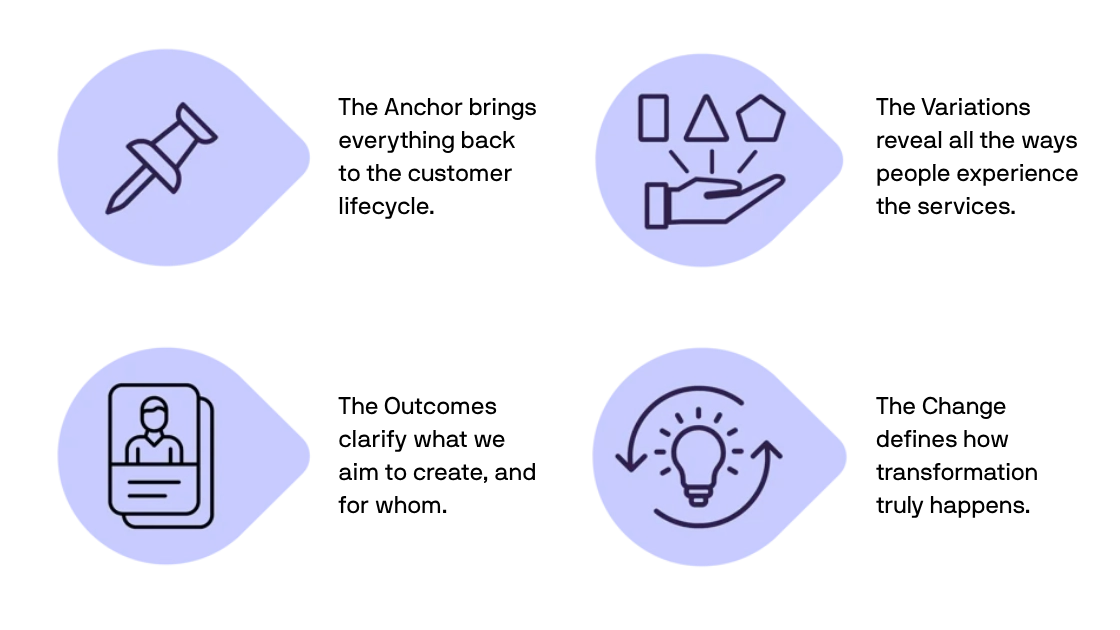
It marks a radical shift: we stop chasing urgency and begin listening to reality.
Each programme in the CC Framework (training, team coaching, individual coaching) responds to a precise need: enabling people to look in the same direction, even when they come from different places. Because this is exactly where transformation breaks or takes shape.
Because it is precisely here that a transformation either breaks down or takes shape.
In most organisations, customer work disperses along the fractures that separate departments, professions, and priorities. Niches of expertise become niches of meaning: everyone sees a piece, names things in their own way, moves at their own rhythm, without a shared field in which to meet.
Customer centricity, instead, requires a pact: acknowledging that the reality of the customer experience is one, even when internal interpretations are many.
This is why the framework’s programmes don’t just introduce new tools. They introduce alignment practices: moments when people learn to rest their gaze on the same point, read the same signals, discuss the same evidence.
In the training, this happens through concrete exercises: mapping a real journey, listening to the customer’s voice without filters, building an outcome framework that forces essential questions.
In team coaching, the work revolves around a real, ongoing challenge something happening now, something that touches everyone’s daily life. And when a team gathers around the same problem, something simple and powerful happens: language narrows, perception aligns, complexity becomes shared.
In individual coaching, the work is more intimate: understanding the horizon of one’s function, how to connect it with customer needs and with the rest of the organisation, how to make decisions that are not reactions but intentional movements within a larger design.
In every case, the goal is the same: to create a common surface where people can recognise themselves.

Customer centricity is born in the weave of everyday decisions, in the language used in hallways, in the moments when a team tries to hold together efficiency and listening, speed and depth, short term and long term. It is a work of presence, of collective intelligence.
Every organisation we meet has a slightly different answer to what customer centricity means for them. But when that answer emerges – when it lands on the table as something alive – the same movement always follows: people begin to see again.
And everything realigns: how we listen, how we design, how we decide. The customer is no longer a target. They become the point toward which the organisation orients itself, to remain meaningful today and in the cycles to come.